

Disclaimer

We’re actively expanding Guideline Genius to cover the full UKMLA content map. Therefore, you may notice some conditions not uploaded yet, or articles that currently focus on diagnosis and management for now.

We are also continuously reviewing and updating existing content to ensure accuracy and alignment with current guidelines. Some earlier articles are undergoing revision as part of this process. Once all content has been fully reviewed, this will be clearly communicated on the platform.

For updates, follow us on Instagram @guidelinegenius.

We welcome any feedback or suggestions via the anonymous feedback box at the bottom of each article and will do our best to respond promptly.

Thank you for your support.
The Guideline Genius Team

Total Live Articles: 381

Newborn Life Support (NLS)

Resuscitation Council UK Newborn resuscitation and support of transition of infants at birth Guidelines 2025

Changes made to this article:

  • Link to the latest 2025 Resuscitation Guidelines updated
  • Minor optimisations made to the flowchart

There were no major changes in the 2025 Resuscitation Council UK guidelines that affect UKMLA-relevant content

Date: 24/11/25

Background Information

APGAR score

APGAR score should be recorded routinely at 1 min and 5 min after birth

Component 0 points 1 points 2 points
Appearance Blue / pale completely Peripheral cyanosis only Pink
Pulse (heart rate) 0 <100 >100
Grimace (reflex irritability) No response to stimulation Weak cry when stimulated Strong cry when stimulated
Activity (tone) Floppy Some flexion Active movement
Respiration No breathing Slow / irregular breathing Strong cry

NLS Guidelines

Key Concepts

Inflation vs Ventilation Breaths

Inflation breaths
  • To be given if the newborn is not breathing or gasping at birth
  • Aim: open collapsed alveoli and establish functional residual capacity
  • Administration:
    • 2-3 sec of inspiratory time per breath
    • 5 are given back-to-back
Ventilation breaths
  • To be given if chest movement is present (indicative of patent airway and delivered volume) but heart rate <100 bpm
  • Aim: maintain established lung volume and provide adequate ventilation
  • Administration:
    • ≤1 sec of inspiratory time per breath
    • Regular breaths given 40-60 per min

Most causes of cardiac arrest in newborns are respiratory problems, instead of cardiac problems. More emphasis is put on optimising ‘Breathing’, if not managed well, any subsequent interventions (including CPR) would be ineffective.

CPR in NLS

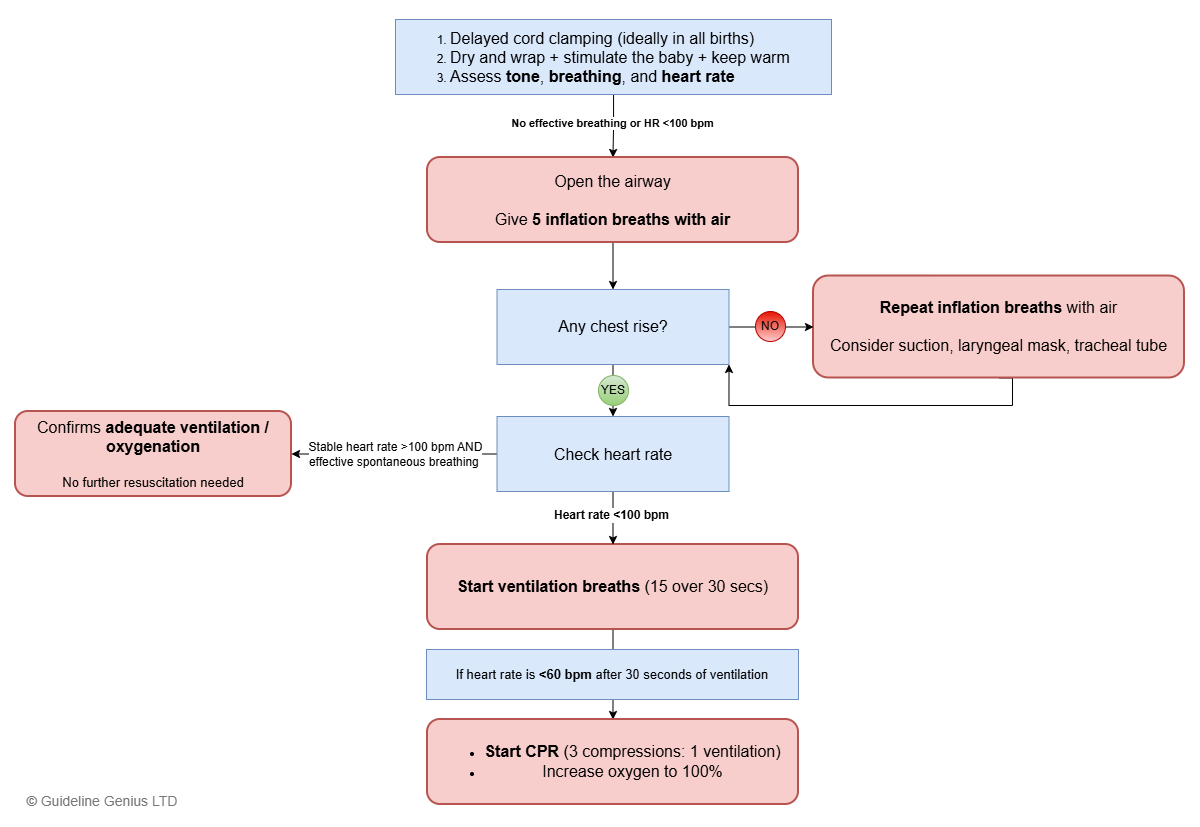
CPR (chest compression to ventilation ratio of 3:1) should only be started if the heart rate is <60 bpm after 30 seconds of good quality ventilation

Do not mix up the CPR ratios in various age groups:

  • Neonates (0-28 days): 3:1
  • Children (1 month – puberty): 15:2
  • Adults: 30:2

Drugs in NLS

IV adrenaline (1:10,000) 0.2 mL/kg should be given after 30 seconds of effective ventilation and chest compressions


Other drugs to consider:

  • Glucose – to reduce the likelihood of hypoglycaemia in prolonged resuscitation
  • Isotonic crystalloid / O -ve blood – for suspected blood loss or shock unresponsive to other resuscitative measures
  • Sodium bicarbonate – for prolonged unresponsive resuscitation with intracardiac acidosis

NLS Algorithm
Discontinuing Resuscitation

Discuss stopping resuscitation if there has been no response after 20 minutes and reversible causes have been excluded.

References

Share Your Feedback Below

UK medical guidelines made easy. From guidelines to genius in minutes!

Quick Links

Cookie Policy

Social Media

© 2026 GUIDELINE GENIUS LTD

Be first to accessour QBank

Sign up to receive major guideline updates and early access when we launch.