

Acne Vulgaris
Acne vulgaris, commonly referred to as acne or pimples, is a chronic inflammatory skin condition affecting the pilosebaceous units, most commonly on the face.
This updated UKMLA guide to acne vulgaris is based on NICE NG198 and NICE CKS, which covers causes, symptoms, diagnosis, and management.
Causes and Pathophysiology
The exact pathogenesis of acne is not completely understood, it is thought to involve:
- Blockage and inflammation of the pilosebaceous unit (hair follicle + hair shaft + sebaceous gland)
- Proliferation of the bacteria Cutibacterium acnes (formerly known as Propionibacterium acnes)
- Androgen-induced seborrhoea (excessive production and secretion of sebum → oily skin)
- Altered follicular keratinocyte proliferation
Risk Factors
Main risk factors:
- Family history
- High glycaemic index diets
- Increased androgen activity
- Polycystic ovary syndrome (PCOS)
- Other conditions associated with hyperandrogenism
Females may also notice increased eruptions before or in the first few days of their menstrual period.
Epidemiology
Acne usually starts at puberty and resolves as adolescence ends
- In a small number of people, acne can persist into adulthood
- A smaller proportion of people may experience acne for the first time in adulthood
Acne is more common in males during adolescence, but more common in females during adulthood.
Clinical Features and Diagnosis
Acne is primarily a clinical diagnosis based on clinical features.
- Consider further investigation if there are features suggesting an underlying endocrine disorder, such as PCOS (see the Polycystic Ovary Syndrome (PCOS) article)
| Affected body areas |
|
| Acne features | Acne lesions can be non-inflammatory or inflammatory
Non-inflammatory lesions = comedones. These are usually NOT red and NOT painful:
To diagnose acne, comedones (non-inflammatory lesions) MUST be present. If not present, consider alternative diagnoses other than acne (e.g. rosacea, folliculitis). Inflammatory acne lesions are usually red +/- painful:
|
| Associated features / complications | Associated seborrhoea (excessive secretion of sebum from the sebaceous glands → oily appearance of the skin and scalp) is common
Complications of acne:
Acne is also associated with systemic comorbidities (including obesity, diabetes, hyperlipidaemia, hypertension, metabolic syndrome) |
Factors that distinguish acne vulgaris from rosacea:
- Acne vulgaris = comedones present + possible scarring
- Rosacea = no comedones + no scarring + flushing / erythema / telangiectasia
Click to See Clinical Images
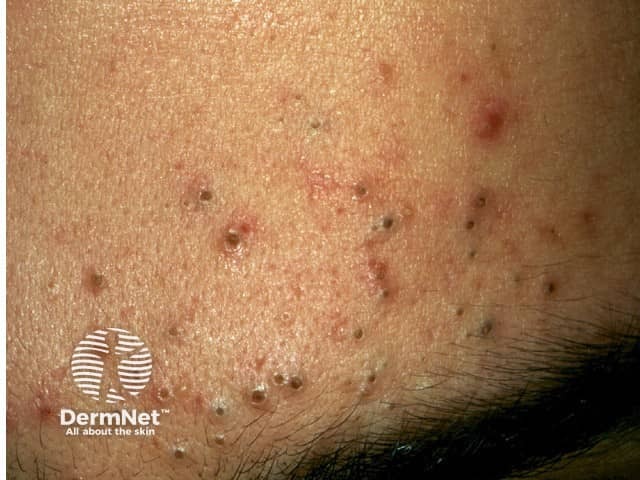
Open comedones (blackhead)
Source: https://dermnetnz.org/topics/acne
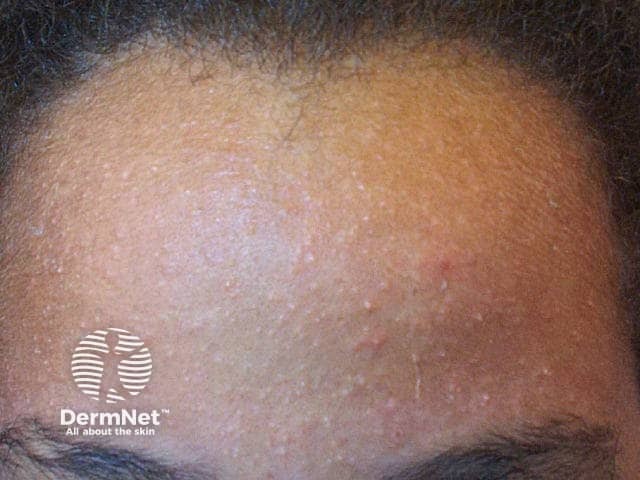
Closed comedones (whitehead)
Source: https://dermnetnz.org/topics/acne-face-images
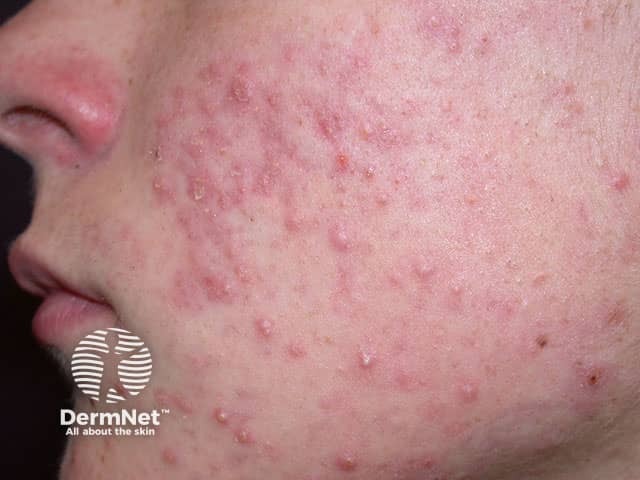
Inflamed acne vulgaris
Source: https://dermnetnz.org/topics/acne
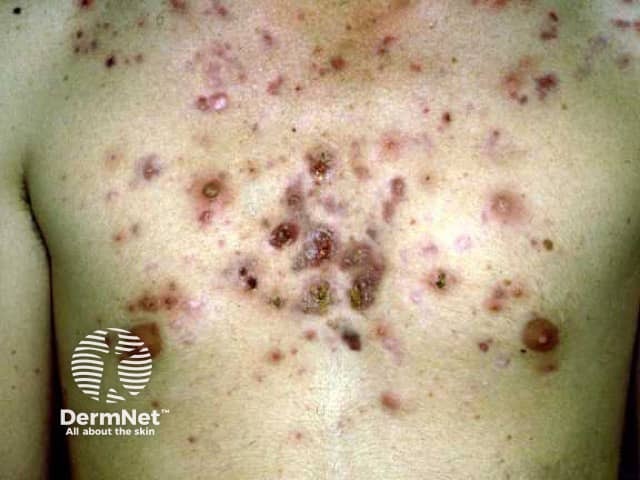
Nodulocystic acne
Source: https://dermnetnz.org/topics/acne
Acne Severity Scale
2 main severities outlined by NICE:
| Severity | Criteria (≥1 features) |
|---|---|
| Mild to moderate |
|
| Moderate to severe |
|
Management
Referral Criteria
Refer to secondary care if any of the following:
- Acne fulminans – same day referral
- Acne conglobata
- Nodulo-cystic acne
- Uncertain diagnosis
Consider referral if any of the following:
- Mild to moderate acne not responded to 2 courses of treatment
- Moderate to severe acne not responded to oral antibiotics
- Acne with scarring
- Acne associated with psychological distress or mental health disorders (e.g. suicidal ideation, self-harm, severe depression or anxiety, body dysmorphic disorder)
- Acne with persistent pigmentary changes
Conservative / General Management
Offer skin care advice:
- Non-alkaline (pH neutral / slightly acidic) synthetic detergent cleansing product twice daily
- Remove makeup at the end of the day
- Avoid
- Oil-based and comedogenic skin care products and sunscreens
- Picking and scratching acne lesions (↑ risk of scarring)
There is not enough evidence to support specific diets for acne.
Pharmacological Management (Active Treatment)
Acne treatment guideline: exam strategy
Remembering all the exact recommended treatment options can be highly challenging.
For exam purposes, the author recommends first remembering the “don’ts” and contraindications, which would help one quickly exclude most of the distractors of an SBA.
Exam-friendly acne treatment principle
Although not explicitly stated in the guidelines, these principles are useful for exam questions and broadly reflect clinical practice.
- Mild to moderate acne
- 1st line: combined topical therapy
- If ineffective: combined topical + oral antibiotic therapy
- Severe acne
- 1st line: combined topical + oral antibiotic therapy
If combined topical + oral antibiotic therapy failed, escalation to secondary care for consideration of isotretinoin.
DON’Ts and Contraindications in Acne Management
Important: 1st line treatment options should always be combined therapy (i.e. dual therapy), but NOT monotherapy.
NICE states explicitly NOT to offer the following:
- Antibiotic monotherapy (either topical or oral)
- Combination of topical and oral antibiotics (if an antibiotic is given, the other drug should be a NON-antibiotic)
These options increase the risk of antibiotic resistance, and antibiotics (oral or topical) work best when combined with topical agents (e.g. benzoyl peroxide).
Medications that are NOT safe in pregnancy:
- Any form of retinoids (both topical and oral)
- Topical retinoids include adapalene and tretinoin
- Oral retinoids include isotretinoin
- Tetracyclines (e.g. doxycycline, lymecycline)
Medications that are safe during pregnancy:
- Oral erythromycin
- Topical clindamycin
- Topical benzoyl peroxide
Management Algorithm (Step-Up Pathway)
1st Line Therapy (Primary Care)
Offer a 12-week course of dual therapy from a choice of the following:
| Acne severity | Recommended therapy |
|---|---|
| Any | Fixed combination topical therapy (i.e. one topical product that contains 2 active ingredients):
**Adapalene and tretinoin are retinoids |
| Mild to moderate | Fixed combination topical therapy (i.e. one topical product that contains 2 active ingredients):
|
| Moderate to severe |
Alternative to tetracycline: trimethoprim / macrolide NICE also recommends considering COCP + topical agents as an alternative to systemic antibiotics in women |
Topical benzoyl peroxide monotherapy may be considered if first-line combination treatments are unsuitable, for example due to contraindications, intolerance, or patient preference to avoid retinoids or antibiotics.
Follow-Up and Step-Up Post-1st Line Therapy
Review the effects of 1st line therapy after 12 weeks
If there is inadequate response to a 12-week course of 1st line therapy, step up as below:
| Mild to moderate acne | Offer an alternative 1st line topical therapy for 12 weeks
If still failed to respond after 12 weeks (i.e. by now the patient has failed to respond to 2 different 12-week courses of 1st line topical therapy) → consider referral to a specialist |
| Moderate to severe acne | Depends if the 1st line therapy included oral antibiotics or not:
|
Secondary Care (Specialist) Therapy
The most commonly offered specialist therapy for acne is oral isotretinoin
- Commonly known as “Accutane”, which is a US brand name. In the UK, the main brand is “Roaccutane”
- Standard dose: 0.5-1 mg/kg until total cumulative dose of 120-150 mg/kg
- In practice, this can take up to 4-10 months
- Consider discontinuing sooner if adequate response and no acne lesions for 4-8 weeks
Oral isotretinoin should only be considered in >12 y/o with severe form of acne that is resistant to adequate courses of standard therapy with topical therapy and systemic antibiotics, such as:
- Acne at risk of permanent scarring
- Severe forms of inflammatory acne (nodulocystic acne, acne conglobata, and acne fulminans)
If an acne flare occurs after starting oral isotretinoin, consider adding a course of oral prednisolone.
When a patient with acne fulminans is started on oral isotretinoin, consider adding a course of oral prednisolone to prevent an acne flare.
Important MHRA safety information about oral isotretinoin
- Oral isotretinoin is highly teratogenic
- Exclude pregnancy before initiating
- Provide effective contraception 1 month before, during and for 1 month after discontinuation
- Assess prior initiating and counsel patients about:
- Mental health side effects
- Sexual function side effects
Other specialist therapies include:
- Photodynamic therapy
- Intralesional triamcinolone acetonide (corticosteroid) for severe inflammatory cysts
Maintenance Therapy
Encourage appropriate skin care and consider maintenance therapy only in those with a history of frequent relapse:
- 1st line: fixed combination topical benzoyl peroxide + topical adapalene
- 2nd line: monotherapy topical adapalene / azelaic acid / benzoyl peroxide
If maintenance therapy is indicated, only offer topical non-antibiotic therapy.
Acne-Related Scarring
If scarring persists 1 year after acne cleared → refer to a specialist to consider:
- CO2 laser treatment
- Glycolic acid peel
References